• After reading NoLogo what are your thoughts on the relationship between consumerism and the media?
My first thought is that the media pours fuel on consumerism, people ask for clues from the media, and get them and consumerism is one of the ensuing consequences. Why does the public crave to be told what to buy, what to desire? The answer may come from the boredom that sets in once the novelty of a purchase wears off. The boredom turns into lust for more, or something new, and the lust smolders waiting for a triggering event. Advertising is part of that triggering event, as is the coverage by other forms of the media. Consumerism sounds like a dirty word, but it really is an appetite. It is the triggering of an appetite that doesn’t get filled with a single purchase.
In a way, the media wants to seduce you, but not only you personally, the seduction needs to happen in massive proportions in which entire segments of society fall for it, creating a new demographic, if possible. That seduction is consummated when you and a hundred-thousand others buy the item. However, the act of buying is only the beginning of a relationship that constantly changes the face of what triggers a person’s wants. Looked at from a different angle, if the media were to suspend advertising and return to public service functions only, the appetite may remain latent in people’s heads but the pace of the world’s economy would come to a crashing halt.
Fads were present from times remote and were triggered by the monarch (or concubine) and what was ‘in style’ or by the shocking effect of conspicuous consumption. The lust was latent nonetheless. What was different in remote times, or at present time in remote, media-less places is, the pace of consumption. The pace of consumption is driven, ironically, by the masses of poor young people that want to be unique in some fashion, that earn money and insist on displaying purchased items both as clues to their identity and as synonyms of their upward mobility. The media exploits this insecurity by creating narratives and experiences that, taken alongside the public’s craving for belonging to a group, make for a very convenient marriage of delusion and fantasy.
Some of these narration-campaigns have been off the air for a while, but their echoes still remain. Philip Morris’ “Marlboro Country” was such a legend, insisting for decades on the association of its cigarettes with depictions of both square-jawed men and landscapes featuring cowboys, horses and cattle. The Marlboro legend proposed a mythical lifestyle that audiences found appealing and drove sales of cigarettes far above the level of consumption that the demographics would suggest.
The remarkable trick the media brings to bear is the justification for specific, targeted consumption. Tobacco could be used in many ways, not just cigarettes, after all. But the cowboys don’t smoke a pipe, nor do they inhale it from a tin, or chew it (actually, they do chew it, in real life, but not in the ads). The magic that an item needs is what the media makes; the media is your trusted friend (Klein 7) that brings you what is cool, attractive, and desirable. Then, it follows that tobacco consumption, without the media, would (perhaps) revert to a strata of society, instead of whole-fabric appeal. This, of course, is the goal of the current ban on tobacco advertising, part of the 1998 Master Settlement Agreement.
The impact of the media on consumerism would seem to be that of an accelerant, a factor that stretches and deepens consumption.
• In what ways do media contribute to things like “branding” and the “co-opting of cool”?
Branding, or brand creation, needs exposure; the media reveals and propels the concept. The media takes the ethereal cool and pimps it for eyeballs (Klein 74). Branding is the process by which a commercial entity intends to create a metaphor for itself. Branding is the transcendence that begins when an artificial, but significant, difference is imprinted into the public’s mind about an item, in the midst of many similar items. The media steps in as a vehicle for the branding, a way to repeat and imprint that difference, until the public stops considering such differences as artificial and treats them as rock-hewn fact.
Levi’s (and all other brands) are just trousers made out of a coarse cotton fabric, dyed a cheap indigo blue copied from what was worn by sailors originally. But, among all the then and now available trousers, Levi’s remain and have become an integral part of the American narrative, be it in the last century or the one before. So then the question is, how does an icon become such? The answer is not intuitive, since a single criterion is not associated with such a status.
Ubiquitousness alone won’t result in legend, but exposure at key moments will make it possible. Milk, potting soil, wood are articles that have resisted branding attempts until the present time. Drinking water, fertilizer and glue have conversely been co-opted into a category that set them apart from their non-branded shelf mates. Try finding plain tap water alongside Perrier, Evian, Aquafina. Or find on the shelf plain fertilizer, and not Miracle-Gro. Good luck finding plain glue, and not Elmer’s glue. It was the media through advertising that turned the idea behind these products into a reality in the public consciousness.
The process of brand manufacture follows a typical pattern. The item is adopted by media creators in an ad agency, where the image is to be shaped and defined. The language is agreed upon and the product hits the store shelves with ads that integrate it into people’s lives. Examples of late are the iPod/iPhone sub-brands within Apple Computer, products that transcend a fixed physical appearance and now could be associated with just about anything. By portraying the iPod as an integral part of everyday life, using hip young people dancing and beat-driven music, Apple co-opted coolness and made history.
Without the media, the convergence of video and print ads as well as movie placement, Apple would have nothing more than another gadget, among many like it. The media then enhances, stylizes, transfers coolness and helps hungry corporations to hawk their wares, much like the old time traveling salesman or carnival barker (of snake oil fame).
• Is your identity shaped by the media? Why do you think so, or why not?
My identity may be shaped by the media more than I care to look. I see a lot of media-pimped images that hit their target and create the right feelings of craving and lust. I’m a kid from the media age, I see things as spun by the TV and have to consciously disengage and deconstruct. Whether we are ready to recognize it, or not, the media shapes us, much as we shape language, or think we do. The shaping takes place right out of the cradle, as soon as we start to notice our surroundings and compare our playthings with others’. We want what others have.
I remember clearly the Matchbox toy car commercials, and how I burned to have a few more for my collection. Likewise, my kids now pine for whatever comes on the TV, my sons don’t do it anymore, but if it’s pink, or has fairy wings, I’m in trouble. They have taken to shouting in unison “I want thaaa-aaat!” whenever the commercials come on. Is the commercial shaping them? I don’t know, but I can only suspect that it has become part of the narrative of their childhood. What parent can turn a deaf ear to a child’s plea for a new toy?
Along the same vein, comes the exposure to music, something that I thought was an important part of my teen years, only to realize that I didn’t need it, or crave it if there was no radio around, or Walkman. For my kids, it is much the same, they have music that gives them something to sing along to, and that they rock out to. I get a thrill out of our shared experience of Rockband, especially the songs from the eighties that they sing so well.
If we add TV shows and layer the exposure, there is no question about it, our cultural GPS in America only works by means of these shared experiences. They all seem to have a common thread running through them, and that is one form of media or another.
• What benefit/detriments come from a society whose ideals are shaped by popular media?
Society will blow around like a leaf in the wind, with no anchors possible. Anchors like tradition and religion become meaningless if society instead chases a hedonistic reflection of itself. In some aspects, it could be argued that the media presents to society an anti religion. Where religion seeks to harmonize the common individual with God, or a state of enlightenment, the media would suggest to the same common man that the hedonistic pursuit and chaotic state of being is a far more organic and natural course to take.
This argument can only move forward if you can, for a moment, think that God is down one path at the fork, and on the other an anti-god. As such, cultures that have persisted through time have built themselves upon an order that was somewhat theocentric (Egyptian, Jewish, Christian, Muslim, Buddhist, Hindu, etc.) and most decidedly not reliant on the media for propagation, at least not commercial media. Likewise, traditions (of the not-exactly religious kind) that have persisted to current times (folklore, celtic tradition, norsk, African) are based on codes that establish safe practices and unsafe or forbidden practices.
The current state of popular media for the westernized world, taken as a whole, is one that eschews self control, rules and responsibility. It can be argued that it stands in opposition to orderly society. In that sense, the USA has the enviable position of being at once, a cradle for religious fervor across the world (evidenced by the rise in the new century of power for a class of political activists that called themselves Christian conservatives) and a major source for the hedonistic and media-centric entertainment world, as evidenced by the proliferation, influence and dominance of western music, technology and culture.
Not surprisingly, many cultures and peoples are much affronted by the immense footprint of American media. There are also dire warnings that our American culture is really the tool of the devil, and as such, they feel they need to strike back with whatever they have at their disposal. Take, for example, the middle east. There is a wide perception that American media is tantalizing and titillating, but ultimately destructive to their way of life. Their traditions, their way of life and their religion could very well be erased by a society like ours. With the modern media being a strong agent for change and disturbance, and our country shaped by it, the fear that we will assimilate them and remake them into our image is well founded.
• What is the effect on democracy?
Consumerism feeds the globalized-corporation model. Democracy aspires to at least not exploit the labor force and not cheat them of union wages and such. Globalized corporations aim for the lowest possible production costs, specifically avoiding unions and jockeying for whatever country will agree to its terms. In economies other than democratic, the masses of fit, hungry, and teachable workers will leap at the chance of employment, even if in the process they exchange human rights for a day’s pay. Democracy is incompatible as an ideal with the modern globalized marketplace.
Authoritarian-type governments are well suited to the modern marketplace however, with few people to answer to, corporations (or more properly speaking, contractors) are free to damage the environment, behave unethically towards their workers and do whatever they need to do to compete and make the product at maximum profit and lowest cost. The media makes consumerism appear appealing, even the norm. The proposition comes full circle when the exploited worker wants to work even harder at the sweatshop to afford the goods that will give him the status that the media bombards him with.
Democracy is subverted in a consumerist state (Klein 441), its people numbed to the abuses perpetrated against faceless cuasi-slaves in equally faceless contractor dungeons. Democratic ideals require people with knowledge of this oppression to behave ethically and vote with their wallets for those in the marketplace trying to make a change, and like Klein advises “…build a resistance…” (Klein 446).
Works Cited
Klein, Naomi. No logo taking aim at the brand bullies. New York: Picador, 2000
Wednesday, April 29, 2009

Sunday, April 12, 2009
Culture Jamming, Sexploitation, & other sundry topics of this week...

It would be dishonest, I think, to say I've never felt like putting a mustache on a face on a billboard, if conveniently located. I thought about ads like these, that are just fabulous examples of co opting an advertising campaign to awaken the masses. Other times, people will take their anger out on signs, leaving their commentary on the content displayed.

The attempts to 'fight back' are puny, but they have an effect.
Sex sells very well. And images like this one are a little misleading. On its face, the ad uses sex to push a product. But of all the companies that do use this approach to advertising, American Apparel uses unretouched photographs, puts workers ahead of pure profits and cares about the immigration status of said workers. I don't think they have a conscience. But what if they did, would it matter that they are only partially ethical in their practices?, I mean, the girl in the pic doesn't look too terribly exploited, does she?
Checking out the site in question, the photography used throughout is on a realist vibe, clearly meant to make the viewer feel like it's pictures of their friends, facebook-solo style. I totally didn't know that disco pants were back, and I challenge my fashion forward classmates (cough-Trisha-cough) to get a pair...
So the mistery lies right there. What to do about those retailers that have what looks like a conscience, but exploit women. Yet they pay their workers more, and hire and keep their manufacturing in Los Angeles, CA not Armpit, Vietnam. Read here about them
Monday, April 6, 2009
Title IX recap...

So my group presented on Friday and our topic was women in the media. My part, presented in tandem with Andrew, was Title IX, a cryptically named piece of legislation that has lots of applications in everyday life.
For some of us that are involved in the field of education, I am through my wife, who is a HS teacher, some of you are employees at the school, others just students, we all have a specific relationship to Title IX in that it provides redress when other legal recourses are not able to do so. For example a student raped by a football player, told that there'd be no school punishment for the rapist, found that Title IX applied to her case and that the school was liable by "exacerbating the damage". The decision, S.S. v. Alexander is intended to send the message that a school needs to treat sex abuse complaints with utmost due diligence, certainly not put it below image considerations. The case is not exactly a no-brainer either. But the female involved found that the local police would not prosecute, making her treatment by the school more egregious.
Friday, March 27, 2009
Big boxes, how they censor, et al...
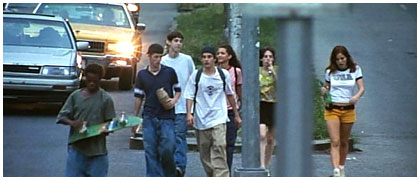
The week that ends today was centered around our class discussion of ch.8 of No Logo, by Naomi Klein. The topic of said chapter is the existence of a movement to censor, perhaps normalize, the output of artists of mostly the recording media in retailers of a certain heft. Corporate entities like Wal-Mart, Target and Kmart, to name a few exercise their influence upon corporate parents to recording artists like Nirvana, Marilyn Manson to have their content restyled until it passes muster or is removed or never placed in shelves.
This practice effectively creates censorship boards at the corporate level, in an otherwise freely expressive society. Censorship per se is not unheard of. The consumer exercises such power on a daily basis. On a community basis, we live among people that share some common belief with us, and we effectively censor our surroundings.
This ability to move into a neighborhood of people of similar income, religion, number of children, etc. is not really practical in other places, like Manhattan. You don't know what kind of freak lives next door there and you tell yourself that you don't care in any case. But you do. The fear is there. You hope it'll be a nice freak, one that won't put you through the ordeal of finding another place to live.
Here in Happy valley, we can be sure that the person next door is actually more wholesome than you, listens to less weird music than you, and we hope they won't judge you as harshly as you do others.
Censorship is at the heart of community building. By common accord a community can ban a set of elements that it determines are hostile to its survival. Similarly, corporate agents can and do select for us those things that they decide are suitable for us, the buying public. We the public have a critical element available to us, and that is the ability to directly research and bypass the retailers by finding online sellers of whatever is banned or unavailable locally.
That democratic freedom, unnamed in the Bill of Rights, of finding whatever you can imagine online is not altogether defended, exactly. Yearly it seems there is an attempt or another to put in place censors to web content.
Let's get real for a moment. The United States won't turn into China anytime soon. But China already leads the world in one thing, and that is the ability to censor content in large scale and in real time. The day may come soon when the people of China will be free to surf the web at will and without fear of plainclothes police visiting them at their homes. For now though, it's our turn to enjoy a pretty close to wide-open society.
In page 169 of No Logo, Klein writes about the personality conflicts of Disney, Inc. and their attempts to distance themselves from one of their holdings that ended up acquiring the exhibition rights for a movie, Kids by Larry Clarke. In her analysis, Klein points out that "On the one hand, [the Disney label] Miramax now has deep resources...; on the other when the company decides whether or not to carry a politically controversial ...work...[like Kids], it cannot avoid how that decision will reflect on Disney and ABC's...reputations as family programmers..." This means that the censorship not only happens in corporate identity layers (at one point, said movie was released by a corporate facade, to further put it away from the parent) but also because, interestingly in this example, censorship was shielding a reality.
I won't defend the movie in question, but I will say that airbrushing, as it were of reality and turning it into an ideal was a topic of discussion in several lectures in Errin's class in the past. In Susan Douglas's book we accepted censorship because it was meant to portray our ideals, not our deeds as a society necessarily. When there was a couple talking about 'going all the way', it really meant that they were in a way, turning the heated moment of passion between teens into something ritualized, debated and full of hand-wringing, like kabuki theater. Reality, um, ain't like that. You know who you are, and what you did. But the point is, we as a society accepted the subterfuge and took it to mean, yes it's reality. A version of it.
In bell hooks' perspective there is censorship that affected her directly, and our american perspective as well. Someone dutifully exercised censorship over the cultural output so that the black footprint was adroitly blended and co-opted to appear as invisible as possible.
Censorship in Klein's book shows that there is a great deal of content that could possibly change our common perspective, but it gets shut down and goes unseen. In war time, we want to cheer for the soldiers, but those that have seen war up close know that the one thing 'people back home' don't get is the harsh images they carry in their scarred minds. Someone censors what the people should view from the battlefield, someone that calls it either kosher for back home or documentary-only footage. Or how about coverage of crime in New Orleans post-Katrina. Do we really know what is going on there, or do we Want to know?. Someone is censoring the feed from those TV stations and making sure the American public doesn't fixate on the 'violent black city' stereotype. Someone is always going to censor content.
I propose we recommit ourselves to always finding the truth, no matter how unsavory it may be...
Friday, March 13, 2009
The Future of Media...one of them, anyway

There's a sea change under way. We've always relied on newspapers to deliver the news for cheap and reliably. Now it turns out the papers are slowly but surely dying out. Denver paper in the link above, Seattle paper here, Chicago paper here, (but referencing LA paper), ditto for Missouri papers, and the story is the same everywhere you look. There's nothing that points to a return of readers to the print media. Where, then, are those readers? funny you should ask. See, the consensus is that readers won't pay for content, or rather, that if you squeeze them out of your website, they'll just migrate to another site that won't charge. And there's plenty evidence that making people go away from your site is a bad deal. The New York Times had a subscription service for a time, then last year, they decided to stop charging and go almost all-free content in order to increase growth predictions. The idea is that you want to show through your server stats that your site has not only volume of hits, but the growth will be there in the future. Then you can pitch your business plan to your prospective advertisers and once more you can be a profitable paper. So the question is, let's suppose that you can make the web site portion of your newspaper profitable, what does it say about your printed on paper side of the business, if the ads space goes unsold? It says it's going to die. It says, let's keep it for the die-hards, but let's make it a luxury item and give it away just for the asking. Do it bundled with fat stacks of ads, though. It's funny, but in the future I see that you'll be able to print on demand, for a fee from a kiosk. Or squint and read the news in your iPhone. I'm not talking about pie in the sky either. There are outlets already that act as portals for multiple news feeds in real time, and there are print-on-demand kiosks like this one that when located at, say, a town library, can give you all the glory of printed paper if you really like it that much. Then there's kindle, that for many will do just nicely, minus the page folding. I like the feel of paper, though...
Since I wrote this, the picture has turned much bleaker. Today I read that a major Chicago Paper, the Sun-Times is under Ch.11. Read it here.

Merchants of Cool commentary...

I commented on Trisha's blog about an iconic girl that has to have a certain combo of brands to feel 'right' about herself, and to be seen in her 'true light'. My point was that like Rushkoff observed, teens and others flock to the perception of 'cool', they surf the perception-wave of cool and dabble in brands they identify with trend-setting or trend-following. The impetus behind the marketing push is the attraction to that slice of the $150 billion pie of money spent by and for teens. The market craves the attention paid to it by the media, and the million ways that they inbreed go largely unnoticed. Read this story at the NYTimes that puts it SO well.
Friday, March 6, 2009
Some thoughts on the freedom of the press...

In today's lecture, we saw the video interview of Jane Akre and Steve Wilson, both reporters at the Fox affiliate in Tampa, WTVT. It was a little like watching a re imagining of the movie The Firm, The Pelican Brief, or maybe Erin Brockovich, going back, maybe even The China Syndrome. A common thread through all these is that there is a group of people operating out of view with the unambiguous goal of silencing those that would tell an inconvenient truth. In one movie it might be a lawyer, in another a journalist but the fact remains that when someone researches the truth, they have an imperative duty to tell it and let the chips fall where they may.
In the rBST or BGH case that we learned about, there were two individuals that were eventually fired from their jobs for reporting their findings and refusing to have their research watered down to not embarrass a wealthy corporation, Monsanto is a large corporation, with revenues in 2008 in excess of 11 billion dollars, employs 18,000 people and is a jealous guardian of its products.
They have sued farmers for a number of reasons, including breeding pigs in a way that Monsanto patented, also for selling grain that was mixed with Monsanto-patented grain in neighboring fields (stuff that the wind blew over, basically) and not least, because farmers had “hormone-free” printed in the carton of milk. They have a number of products that are nominally for human consumption, but have associated with them either questionable performance in animal-trials, or like the Terminator seed technology, that causes plants to die at harvest time, (making the farmer to have to buy more seed every year) that are of a disturbing nature to the consumer.
The rBST controversy has made the public to stampede to organic labels. Only time will tell if these labels mean anything, or similar statements made, like “rBST-free” in fact mean it. Monsanto has been sued for polluting waterways with grievous amounts of PCBs, and lest we think that it was better in the past, it has been associated with a number of industrial accidents, some of them quite spectacular. This makes the Posilac case, as rBST is trademarked by Monsanto, a memorable one. The hormone in question is alleged to be already present in the animal, but if a synthetic version is injected, then another hormone triggers a 15-20% increase in output, albeit at the risk of a number of health problems for the cow.
The marketplace seems to have shied away from the controversy, and Monsanto responded by forming a lobbying group to refute and dilute the criticism. It doesn’t help the public perception when it becomes known that FDA, EPA top-tier people, even a sitting Supreme Court Justice have been in their payroll.
The question one must ask as a consumer is, do I want to be complicit with such a bully of a corporation? You may find that its tentacles reach too deeply into our American lifestyle. Their products dominate the corn and soybean crops in the US, and perhaps in another post we can explore that issue. Suffice it to say, unless you grow your own food (and I mean using your own imported seed, or killing wild animals) you can’t avoid eating products that are directly linked to this corporation.
What I admire in Akre and Wilson is that they took a stand on principle and they did not back down, even if it meant that they’d be fired or ruined. Of late, following the reversal of their win at the lower levels, Fox is suing them for lawyer’s fees, more than a million dollars’ worth. They represent the ethics I admire.
Subscribe to:
Posts (Atom)


